One of the most stable strategies on Polymarket is buying NO outcomes for (geo)political events. You can find many accounts with very impressive near-linear capital growth doing exactly that: buying NO outcomes at 80c-95c and holding them until expiration. The curve often looks almost boring in the best way, because the strategy is based on repeatedly taking small, high-probability outcomes.
Example account: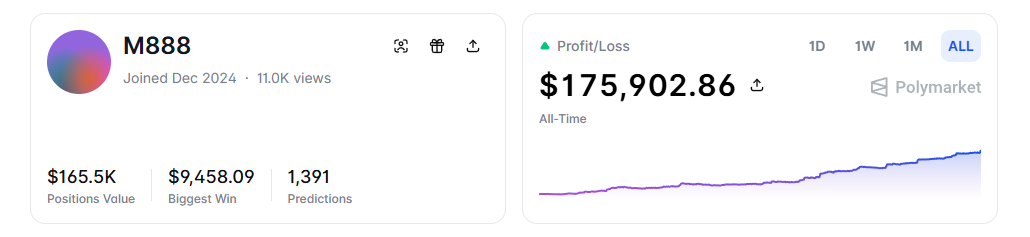
Let’s think about why this is possible, and why this is possible specifically for those (geo)political events, while it may not be possible for other types of assets like finance or weather. At first glance, all prediction markets look similar, but the underlying information structure is very different across categories.
Recently, I built a bot that just buys everything priced in the range [80c,95c] to sell at 98c. Since we have labels on events, I gathered some interesting statistics about label efficiency for this kind of trade. This gave me a cleaner way to compare categories.
And yes, the edge is pretty consistent in Politics/Geopolitics labels, less noticeable for Culture, and negative for things like Finance/Crypto/Weather/Sports/ESports. So the behavior is not random; it clusters by market type.
So basically you don’t need to be an expert; mass-buying of everything under specific labels also works. That is probably the most surprising part, because it suggests the edge is structural rather than driven by superior event-level forecasting.
What is so special about (geo)politics bets?
My guess is that you can’t build a decent model to predict such outcomes. You can’t build a model that gives you a specific date of a military invasion or a ceasefire in an existing conflict. No model -> no “fair price” estimates arbitrageurs could use -> market is purely driven by emotions, overpricing probabilities for events currently in mass-media focus. When pricing is narrative-heavy, persistent mispricings can survive longer than expected.
For Finance, Crypto, and even for Weather, you may build a pricing model. Traders with models remove significant distortions near price-range edges. That does not make those markets perfectly efficient, but it usually makes easy edge-capture strategies much harder to sustain.
There’s another reason why this edge still exists and is not being arbitraged away.
This kind of strategy requires capital allocation. You have to invest 90c into a position to eventually get 10c of profit, and you risk losing that 90c if the event still happens. The return profile can look attractive over many trades, but each individual loss is large relative to the expected gain on one position.
Also, it requires a basic understanding of diversification principles; there are cases when over-concentrated NO buyers are wiped out by an event that suddenly happens. Correlation between markets is easy to underestimate, especially during geopolitical shocks. If several related markets resolve in the same direction, a concentrated portfolio can break quickly.
That is not the kind of strategy most Polymarket users are interested in. A “retail” Polymarket enjoyer (kindly referred to as a “degen” on Discord/Twitter) often has the opposite strategy: seek super-high returns on (often quite limited) investment, which leads to lottery-style gameplay like buying 1c bets and hoping for a 100x return. This preference naturally pushes attention and liquidity toward long-shot outcomes rather than boring, capital-heavy NO positions.
Lottery-style behavior supports distortions on the edges of the price range, making the “nothing ever happens” strategy possible and consistent.